A travel tech company is not a single product you buy. It is the layer that decides how your business sells, confirms and services every trip. Travel tech companies build the software that connects suppliers, sellers and travellers, from distribution networks and booking engines to payments, servicing and reporting.
The right provider depends on your booking model, supplier access, operational needs and budget. This guide explains what a travel tech company actually does, the types of provider on the market, how bookings flow from search to settlement, and a six-point scorecard you can use to choose with confidence.
Key takeaways

- Travel technology is the tooling; a travel tech company is the business that builds and runs it.
- Most providers sit in the commerce layer (how trips are shown and sold) or the operations layer (what happens after booking) — rarely both.
- A technical connection to a supplier is not the same as a commercial agreement to sell its inventory.
- Score vendors on integrations, ownership, support, functionality, security and total cost — never on a "top 10" list.
What Is a Travel Tech Company?
A working definition
A travel tech company develops, operates or licenses technology that helps travel products get discovered, sold, paid for and serviced. That covers a wide range: a global network linking agents to airlines, an airline reservation system, a hotel property platform, a consumer marketplace, or a platform that lets an agency run its own booking website.
The phrase "travel technology" describes the tools themselves. The phrase "travel tech company" describes who builds and runs them. Most buyers searching for one want to know which kind of provider solves their particular problem.
Travel tech vs "tech travel"
Searchers sometimes type "what is tech travel". In this guide it means technology used in travel: the systems behind searching, booking, paying and managing trips. It is not a separate industry from travel technology.
Where technology sits in the travel stack
The scale of the market explains why so many kinds of provider exist. Skift Research's State of Travel 2026 report describes a global travel industry worth about $11 trillion, organised into four layers: consumers, commerce, operations and experiences.
Travel tech companies sit mostly in the commerce and operations layers. Commerce covers how trips are shown and sold. Operations covers what happens once a booking exists. A provider that handles only the first layer leaves you to solve the second yourself.
Six types of travel tech company
Not every travel tech company competes with every other. Comparing a global distribution network with a white-label booking platform is like comparing a motorway with a car.
- Distribution infrastructure (GDS): connects sellers to airline, hotel and car inventory. Typical buyers: agencies, OTAs, TMCs.
- Airline and hotel IT: runs reservations, inventory and check-in for suppliers. Typical buyers: airlines, hotel groups.
- Consumer marketplaces: sell trips directly to travellers. Typical buyers: travellers, and suppliers listing inventory.
- Corporate travel technology: policy, approvals and expense for employee travel. Typical buyers: companies.
- Hotel technology: property management, channel and rate tools. Typical buyers: hotels.
- Booking-platform providers: give a travel business its own booking portal and back office. Typical buyers: agencies, tour operators, wholesalers, startups.
TravelBookingPanel belongs in the last row: a platform that pairs a customer-facing booking site with supplier integrations and an admin system for the business running it. If that model fits you, see our white label travel booking panel guide.
How Travel Companies Work: From Search to Settlement
Asking how travel companies work really means asking what happens between a traveller clicking search and the business getting paid. The answer has four layers.
Supply: where inventory comes from
Inventory starts with airlines, hotels, car rental firms, tour operators and the wholesalers and aggregators that bundle them. A travel business rarely owns any of it. It sells access to it, which is why connectivity matters more than most buyers expect.
Connectivity: GDS, NDC and direct APIs
GDS
A global distribution system is, as AltexSoft's GDS comparison puts it, a network acting as a middleman between travel agents and travel service providers. The three best-known are Amadeus, Sabre and Travelport. An agency connects once and gains access to many suppliers, usually under commercial terms with the GDS.
NDC
IATA's NDC standard (IATA) is an XML-based data standard for communication between airlines and sellers, open to intermediaries and IT providers. It matters because it lets airlines show richer fares and extras. It is a technical standard, not a commercial model, so access terms still differ airline by airline.
Direct and aggregator APIs
Many suppliers also offer APIs directly, or through aggregators. They can be quicker to integrate, but each one carries its own coverage, booking rules and contract.
The distinction that trips up new buyers: a technical connection is not the same as a supplier agreement. A platform can be able to talk to a supplier while your business still needs the commercial arrangement that lets you sell its inventory.
The sales layer: B2C and B2B portals
Customers see a B2C website. Sub-agents and partners use a B2B portal with their own logins, markups and wallets. A business model that serves both needs both experiences, driven by the same booking engine and records. Our B2B travel booking panel guide covers the agent-portal side in detail. Pair the portal with a travel CRM system to manage agents, leads and follow-ups in one place.
The money and servicing layer
After payment comes the work customers never see: tickets and vouchers, changes, cancellations, refunds and reconciliation. Card payments also bring security obligations. The PCI Security Standards Council administers PCI DSS, and version 4.0 was published in March 2022, so ask any provider how its payment flow handles cardholder data.
The booking lifecycle in nine steps
- 1. Search: customer or agent queries suppliers. What can go wrong: slow or partial supplier responses.
- 2. Availability and price check: live fare or rate is confirmed. What can go wrong: price changes between search and booking.
- 3. Booking: request sent to the supplier. What can go wrong: timeouts, duplicate requests.
- 4. Supplier confirmation: reference returned. What can go wrong: confirmation delayed or refused.
- 5. Payment: customer or agent pays. What can go wrong: declined or interrupted payment.
- 6. Ticket or voucher: document issued. What can go wrong: issuance failure after payment.
- 7. Servicing: changes, name corrections, requests. What can go wrong: manual follow-up outside the system.
- 8. Cancellation and refund: rules applied, money returned. What can go wrong: unclear supplier rules.
- 9. Reconciliation and reporting: bookings matched to payments and suppliers. What can go wrong: spreadsheets that disagree.
A platform worth evaluating lets you see and manage every step in one place. Confirm in a demo exactly which steps your chosen setup handles.
The Travel Technology Stack: Six Layers Behind Every Booking
The six layers
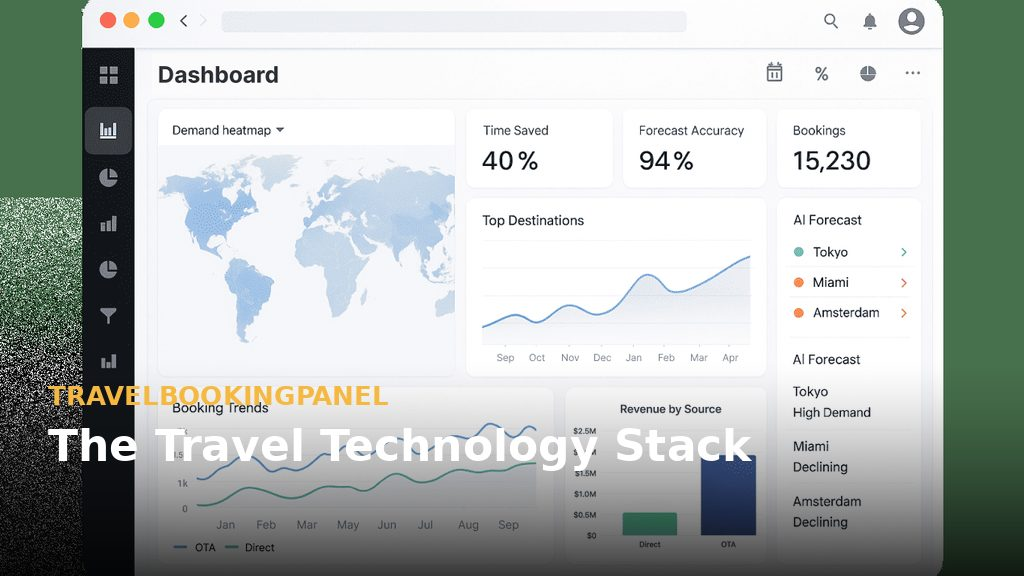
Every online travel business runs some version of the same stack, whether it built it, bought it, or stitched it together:
- Customer-facing website where bookings start.
- Booking engine that searches, prices and creates reservations.
- Supplier APIs and GDS that supply live inventory.
- Payment processing that takes and records money.
- Admin system for bookings, markups, staff and rules.
- Reporting layer for sales, status and exceptions.
When separate tools stop being enough
A website, a supplier login and a spreadsheet can work at first. The signs they no longer do are practical:
- Staff re-type the same booking into more than one system.
- Nobody can say quickly which bookings are unpaid, unticketed or awaiting confirmation.
- Markups and agent commissions live in someone's head or a sheet.
- Adding a supplier means rebuilding part of the website.
If several of these sound familiar, a connected platform is worth comparing. Our guide to travel booking software covers that comparison from the agency side.
Booking Engine vs Travel Portal vs Complete Travel Platform
These terms are often used interchangeably, which makes vendor pages hard to compare.
- Booking engine: core job is search, price, book. Includes admin and reporting rarely. Includes supplier connections variably. Best fit: teams adding booking to an existing site.
- Travel portal: core job is a customer or agent-facing site. Includes admin and reporting sometimes. Includes supplier connections variably. Best fit: businesses needing a front end.
- Complete travel platform: core job is portal, engine, back office and reporting together. Includes admin and reporting by definition. Includes supplier connections variably by setup. Best fit: businesses running the whole workflow.
What a new travel business needs first
Start with the workflow that limits you today, then add complexity only when it solves a defined problem. A new agency selling flights and hotels does not need every module on day one. It needs a reliable lifecycle, clear supplier terms and a way to see its own bookings.
Best Travel Technology Companies: Categories, Not a Ranking

People search for the best travel technology companies, or ask what travel company is the best. There is no honest single answer, because the companies serve different jobs. A ranking would need independent evidence and a published method, and a vendor blog cannot supply either.
Infrastructure names
Amadeus, Sabre and Travelport are the best-known distribution networks and are central to flight content worldwide. They are infrastructure you connect to, usually through an agreement, not a ready-made storefront.
Consumer marketplaces
Booking Holdings and Expedia Group run large consumer travel brands. They are useful to know as the competition your customers also see, but they are not tooling for an agency to run its own brand.
Ready-made booking platforms
This is where an agency, wholesaler or startup usually shops. Providers here package a booking site, supplier integrations and an admin system. TravelBookingPanel is one such platform, with modules for flights (Airways), hotels, tours, Umrah and visa. It is worth evaluating if you need its supported portal, booking management and reporting capabilities.
Why there is no "top 10" here
The right provider depends on your booking model, supplier access, operational needs and budget. Use the scorecard below instead of someone else's list.
The Travel Tech Vendor Scorecard
Score each shortlisted travel tech company on the same six criteria. Weight them yourself: a wholesaler may care most about integrations, a first-time founder about ownership and cost.
- Integrations: ask which suppliers work today, and which need a separate agreement. Evidence to request: documentation, a live search. Red flag: logos with no supported products listed.
- Ownership: ask who owns the code, domain, customer data and brand. Evidence to request: licence terms in writing. Red flag: vague answers on data access.
- Support: ask who answers, how fast, and for how long. Evidence to request: written support scope. Red flag: support ends at launch.
- Functionality: ask whether it covers your actual lifecycle steps. Evidence to request: a walkthrough of your own scenario. Red flag: demo uses only the easiest case.
- Security: ask how payments and customer data are handled. Evidence to request: payment-flow explanation, PCI position. Red flag: no clear answer.
- Total cost: ask what the full cost over time is. Evidence to request: itemized quote. Red flag: recurring or per-transaction charges revealed late.
What to verify before paying
Before signing with any provider, get these in writing:
- Whether you can use your own branding and domain.
- What data you can export, and when.
- Which supplier contracts are yours and which belong to the provider.
- How pricing is structured, and what is excluded.
- What setup steps fall on your side.
Counting total cost of ownership
Setup is only part of the bill. Add subscriptions or licence fees, integration work, transaction charges, maintenance, and your own staff time. Compare providers on the same list, and use your own figures rather than industry averages.
Applying the scorecard to TravelBookingPanel
To be even-handed, here is how TBP looks against the same criteria. On ownership, the pricing page describes a one-time licence with source code access instead of a subscription, with features depending on the plan. Confirm the exact licence terms before relying on them. On integrations, the pre-connected supplier catalogue is smaller than some competitors', and additional suppliers can be integrated on request as a separately scoped engineering add-on. Whether that fits depends on the suppliers your business actually uses.
How to Launch Under Your Own Brand Without Building Everything

Build, buy, white-label or hybrid
- Build: custom software from scratch. Trade-off: most control, longest path, ongoing engineering.
- Buy SaaS: subscribe to a vendor's product. Trade-off: fast start, ongoing fees, less control.
- White-label: license a ready platform under your brand. Trade-off: faster launch, depends on the platform's scope.
- Hybrid: platform plus custom extensions. Trade-off: flexibility, needs clear scoping.
A sensible launch path
- Decide your model: B2C, B2B or both.
- Choose the modules you will actually sell.
- Secure supplier agreements.
- Set up payments and test the lifecycle with real scenarios.
- Go live and review the reports.
Setup time depends on your suppliers, payments and approvals, not only on software, so ask any provider for a realistic plan rather than a headline number.
What Each Buyer Should Prioritise

- Travel agency owner: booking management, reporting. Why: replace scattered records.
- Travel-tech startup: ownership, extensibility. Why: avoid lock-in as the product evolves.
- Tour operator: tours module, itinerary handling. Why: packages differ from simple bookings.
- Wholesaler: B2B agent portal, markup control. Why: many agents, many rates.
- First-time entrepreneur: total cost, support. Why: avoid surprise spend.
Wholesalers and agency networks in particular should check flight integrations and the agent portal against their own agent structure.
How to Decide

Write down the lifecycle steps your business must handle, then score each travel tech company on integrations, ownership, support, functionality, security and total cost. Shortlist two or three, and test each against your own scenarios. If a ready-made, white-label setup looks right, talk to TravelBookingPanel about your requirements and ask for a walkthrough of the steps that matter to you.
More resources from our network
- TravelsTech — travel technology news and platform guides.
- TravelBookingPortal — travel portal development and OTA guides.
- TravelBookingPanel Pakistan — travel booking panel for Pakistan agencies.
- Travel CRM System — CRM software for travel agencies.
- TravelsOTA — online travel agency platform resources.
- Bookin.pk — online booking guides for travel businesses.
- Airways.pk — flight booking and GDS integration guides.
- Jovago.pk — hotel booking platform guides.
- FindMyAdventure.pk — tour and adventure travel guides.
- Buscaro.pk — bus and ground transport booking guides.
- IATA.co — IATA and airline industry resources.